
A Prepared Reply Is a Draft, Not a Sent Message
Key Takeaways
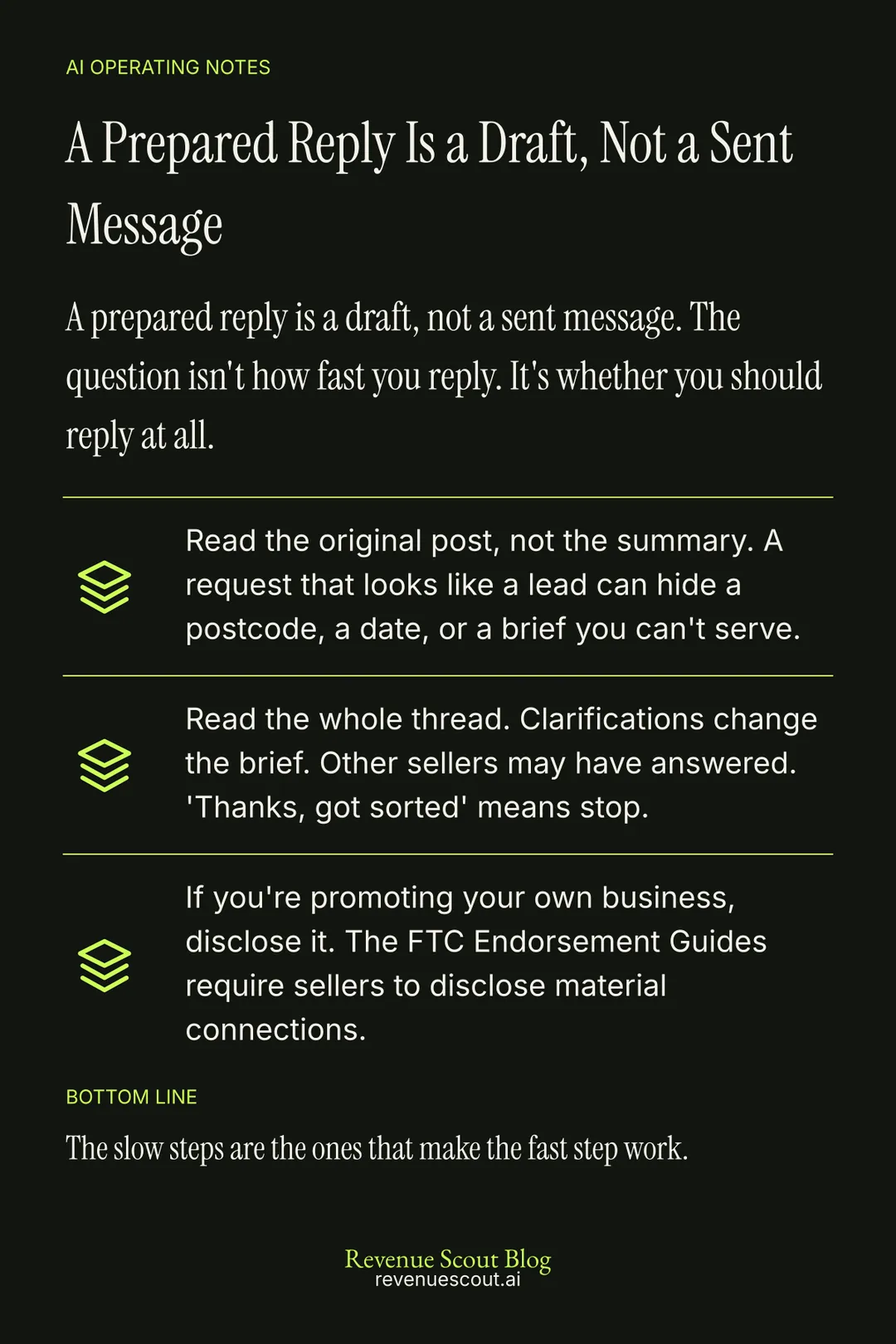
- A prepared reply from Revenue Scout is a draft, not a sent message, and not proof the person wants what you sell. The question isn't how fast you can reply. It's whether you should reply at all, and if you do, what would actually help this person.
- Read the original post, not the summary. A request for 'a cleaner next week' might mean a one-off deep clean, in a postcode you don't cover, on a day you're booked. Fit is boring to check. Check it anyway, because a reply that stretches the truth sits in public where other buyers can read it later.
- Read the whole thread before you draft. Clarifications change the brief, other sellers may have answered already, and 'thanks, got sorted' means stop. A reply that ignores the thread reads as a reply that ignored the person.
- If you're promoting your own business, disclose it. The U.S. Federal Trade Commission's Endorsement Guides require sellers to disclose material connections when promoting their own business in public forums. If you own the business, say so. Don't pretend to be a neutral commenter.
- The sequence is: read the original post, read the thread, decide if the fit is real, draft a specific useful answer in your own voice, disclose you're the seller, and post it manually. The slow steps are the ones that make the fast step work.
Why a prepared reply is only the start of the work
A prepared reply is a draft. It's not a sent message, and it's not proof that the person on the other end wants what you sell. Revenue Scout surfaces public conversations that look like buying signals. What happens next is your call, and that call is the whole job.
The question isn't "how fast can I reply." It's "should I reply at all, and if I do, what would actually help this person?"
That's what this piece is about. How to read the context around a public buying request before you post a manual reply, and how to keep the reply honest.
Is this request actually a fit for what you sell?
Before you write anything, read what the person wrote. Not the summary. The original post.
Public buying requests get described in shorthand. Someone asks about "a cleaner for next week" and your eye jumps to the word cleaner. But the post might say they need a one-off deep clean before a tenant move-in, in a postcode you don't cover, on a day you're already booked. The request looked like a lead. The underlying need isn't one you can serve.
This is the first filter, and most of the discipline sits here. If the request doesn't match what you offer, in the area you serve, on terms you can meet, the right move is to not reply. A reply that stretches the truth to fit a mismatched request wastes the buyer's time and yours. It also sits in public, where other potential customers can read it later.
Fit is boring to check. Check it anyway.
What is the original conversation telling you?
If the request is a fit, read the thread. All of it.
Public posts usually have replies underneath. Other sellers may have answered already. The buyer may have clarified what they want. They may have ruled out certain approaches, named a budget range, said they already picked someone, or asked a follow-up question that shifted the brief.
A reply that ignores the thread reads as a reply that ignored the person. A few things worth checking before you draft:
- What has the buyer added since the original post? Clarifications change the brief. A reply to the original wording can contradict what the buyer said two comments down.
- What have other sellers already said? If three replies offered the same generic pitch, a fourth adds noise. If the buyer has pushed back on a particular approach, repeating it doesn't help.
- Has the buyer indicated the thread is closed? "Thanks, got sorted" means stop.
- Is the tone of the thread casual or formal? Match it.
Reading the thread takes a minute. It's the difference between a reply that lands and a reply that gets scrolled past.
What does a useful specific reply look like?
Once you've confirmed fit and read the thread, the reply itself is the easier part. Keep it specific to what the buyer asked.
Specificity means answering the actual question. If the buyer asked whether you cover a particular area, say yes or no. If they asked how soon you can start, give a realistic window. If they asked about a specific material, service, or constraint, address that constraint directly.
A few things to avoid in the draft:
- Invented facts. Don't quote a price you haven't set. Don't promise a result you can't deliver. Don't claim a capability you don't have. If you don't know something, say you'll check and come back, or ask the buyer a clarifying question.
- Padding. The buyer is scanning. Long paragraphs about your company's values before the answer to their question are a reason to scroll.
- Pressure. "Reply today for a discount" tactics don't belong in a reply to a public buying request. The buyer asked a question. Answer it.
- Copy-paste language. If your reply reads like it could sit under any post, it probably will get treated that way.
The draft Revenue Scout prepares is a starting point. You read it, edit it in your own voice, and post it manually. Nothing goes out automatically. That gap exists on purpose. It's where your judgement about the specific person and the specific thread gets applied.
What about disclosure when you're promoting your own business?
This part matters, and it's the one small business owners most often miss.
If you're replying to a public buying request to promote your own business, that's a material connection, and the U.S. Federal Trade Commission's Endorsement Guides require sellers to disclose material connections when promoting their own business in public forums. [3] [1] [4] [2]
In practice, if you own the business, say so. If an employee is posting on behalf of the business, they should say so. The point of disclosure is that the person reading the reply understands who's talking and why.
This isn't legal advice. If you're unsure whether a specific disclosure meets the Guides for your situation, read the FTC's own guidance or ask someone qualified. The principle is simple: when you're the seller, don't pretend to be a neutral commenter.
When should you decide not to reply?
Worth saying out loud, because the whole point of surfacing public buying requests is that you can reply. The option to not reply is still the option that protects your time and the buyer's attention.
Clear reasons to skip a request:
- The request isn't what you sell.
- You can't meet the location, timing, or budget the buyer named.
- Another seller has already given the answer you'd give.
- The buyer has said they're sorted.
- The thread has drifted into something you can't help with.
A smaller public footprint of relevant, useful replies serves a small business better than a larger footprint of generic ones. The buyers scrolling past the thread tomorrow are reading what you wrote today. Make it worth reading or don't write it.
What this means in practice
A lead is a potential customer. It's not a confirmed buyer, and it's not a sale. Treating a surfaced public buying request as a prompt to post a sales pitch gets the sequence wrong. The sequence is: read the original post, read the thread, decide if the fit is real, draft a specific useful answer in your own voice, disclose that you're the seller, and post it manually.
The slow steps are the ones that make the fast step work.
If you want more on how Revenue Scout thinks about lead discovery and the gap between a signal and a sale, the about page covers the shape of the work, and the blog has more pieces on reading public signals carefully.
What's the last public reply you posted that you'd actually want a future customer to read?
Research notes
Research checked 1 November 2026.
Sources
- Disclosures 101 for Social Media Influencers | Federal Trade Commission, Federal Trade Commission Published 24 October 2019. Retrieved 1 November 2026.
- The Deep Dive: FTC Updates Endorsement Guides for Modern Marketing and Advertising - Davis+Gilbert LLP, Davis+Gilbert LLP Published 11 July 2023. Retrieved 1 November 2026.
- FTC's Endorsement Guides: What People Are Asking | Federal Trade Commission, Federal Trade Commission Published 7 September 2017. Retrieved 1 November 2026.
- Endorsements, Influencers, and Reviews | Federal Trade Commission, Federal Trade Commission Retrieved 1 November 2026.